Watching Your First Rugby Match: Follow One Restart
Follow one rugby restart to read your first match more clearly: see how the kick sets the field, how players respond, and what each side chooses next.
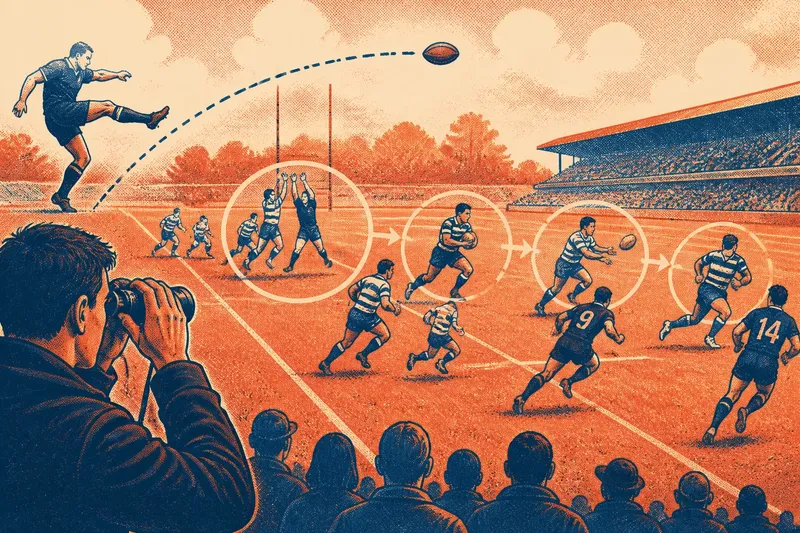
The referee signals for a kickoff, one team sends the ball high, and players begin moving before it lands. If this is your first rugby match, follow one restart as a short tactical story: how the kick shapes the field, how players react, and what the teams choose next.
That view is more useful than trying to identify every player or memorize every law at once. A kickoff reveals how a team balances contesting the ball against covering the space behind its chasers. A lineout or other restart has its own structure, so treat each type on its own terms rather than assuming the same pattern applies.
Why does a kickoff spread players across the field?
The ball can travel farther than your eyes expect. The receiving team spreads out to cover likely landing areas, while the kicking team sends players forward to contest the catch or pressure the first move.
Before the kick, note where the receiving players are positioned. Then follow the ball to its landing area and notice how the kicking team’s chasers approach it. A tight group of chasers may challenge the reception; players held back may be guarding against a return kick or run into open space.
You do not need to follow every chaser. Pick one and see whether the receiver has time to catch and act, or has to deal with immediate pressure. That gives you a concrete way to read the kick’s effect without guessing what the coach intended.
What can you learn from a messy reception?
A clean catch is obvious. A loose ball or a crowded landing is not. Bodies may hide the ball, and the referee’s view may be clearer than yours from the stands.
Look for a player who emerges with the ball or makes a clear pass or kick. If you cannot see possession, use the referee’s signal as a clue, not a substitute for certainty. Players’ movement can help too, but a team pressing forward is not proof that it has the ball.
Say a kickoff lands among several players, and the receiving team’s fullback gathers it before passing to a teammate. The sequence suggests the receiver had enough control to move the ball away from the landing area; if a chaser arrives just as the pass is made, the kick also forced a hurried decision. Those are observable details, not a verdict on whether the kick was good.
Why might the receiver pass, run, or kick?
The receiving team does not have to run the ball straight back. A pass can move it away from a crowded landing area. A run can exploit a gap. A kick can send play elsewhere, though it may hand the other team a chance to counterattack.
Watch the first action after the reception and the space around it. If defenders have closed in, a quick pass or kick may be a way to avoid being trapped. If open field lies ahead, a run may make more sense. The choice is shaped by the immediate picture, not by a rule that every restart must be returned the same way.
How do different restarts change the picture?
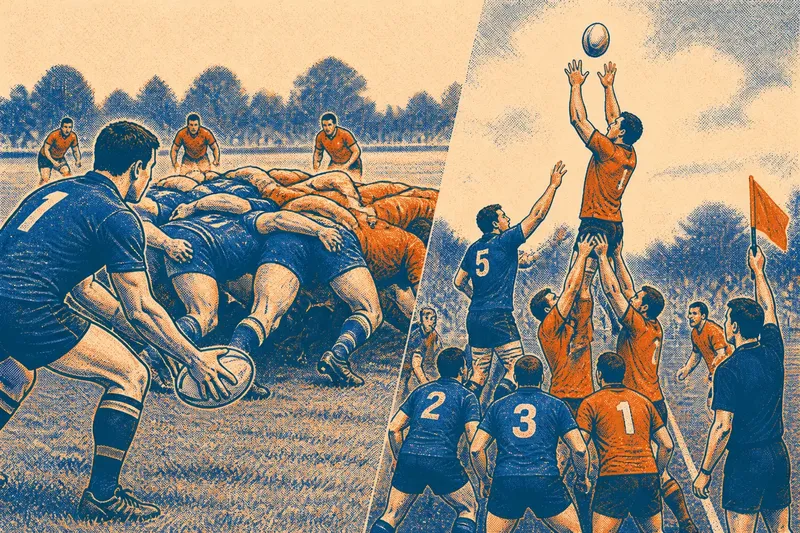
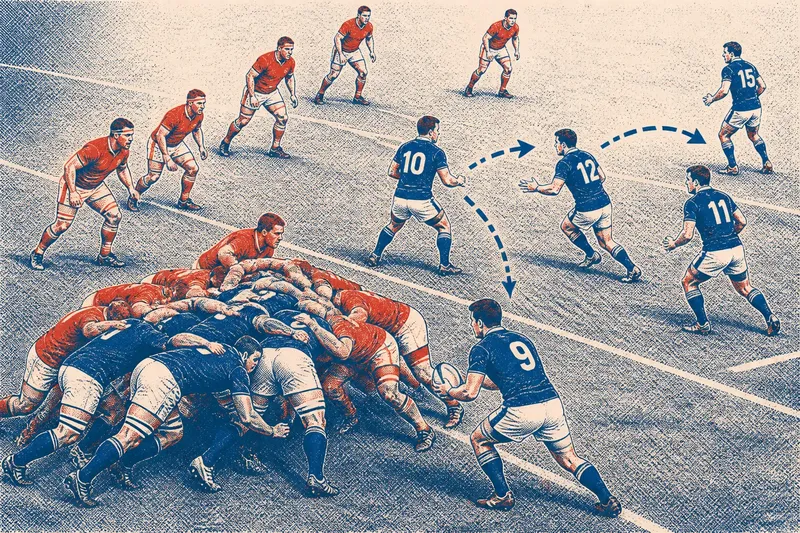
A kickoff begins with the ball travelling through the air toward the receiving side. A lineout starts at the touchline, where teams organize for a throw and contest. A scrum is a set-piece restart in which the two forward packs bind and contest the ball. Each gives you a different focal point: the landing area at a kickoff, the throw at a lineout, and the ball’s movement through the scrum.
After the ball leaves a set piece, the next decision may be a pass, run or kick. You can follow that choice without treating a lineout or scrum as another kickoff. The setup tells you what kind of contest is taking place; the ball’s next movement tells you where play is headed.
What do viewers often ask about rugby restarts?
Where should I look after the kickoff?
Watch the ball’s landing area, then the receiver and the nearest chaser. Once the ball is secure, shift your attention to the first pass, run or kick.
Can the receiving team kick the ball straight back?
Yes. It may return the ball, pass it or run, depending on the space and pressure. Notice whether the choice moves play into open field or gives the opposition another chance to attack.
What should I watch when a kickoff goes out?
Watch the referee’s signal and where the next restart is set. The laws governing a ball that goes out can depend on how and where it crossed the touchline, so a broadcast replay or the referee’s explanation can clarify the decision.
Do I need to know every law to follow a restart?
No. Start by noticing the setup, the contest and the team that emerges with the ball. When a stoppage changes play, the referee’s signal can help explain what happens next.
How can one restart make a match easier to follow?
Imagine you are watching a kickoff from the stands. The receiving team has two players near the expected landing area and several others spread behind them; the kicking team sends a high ball and one chaser arrives close to the receiver. The receiver catches it, then passes to a teammate instead of running into the chaser. You can now describe the sequence: the kick drew the receiving side toward the landing area, the chase applied pressure, and the receiver used a pass to avoid it. You do not need to decide whether the tactic succeeded until you see what happens next.
For a first rugby match, a kickoff is a useful viewing anchor because its setup and outcome are easy to compare. Notice how the teams arrange themselves before the next one and whether their choices change. That small contrast can tell you more about their plans than trying to keep track of every collision on the field.