Scrum or Lineout: What Changes at the Restart?
Scrum or lineout: understand how each restart works, what the teams can contest, and why the laws create different attacking and defensive options.
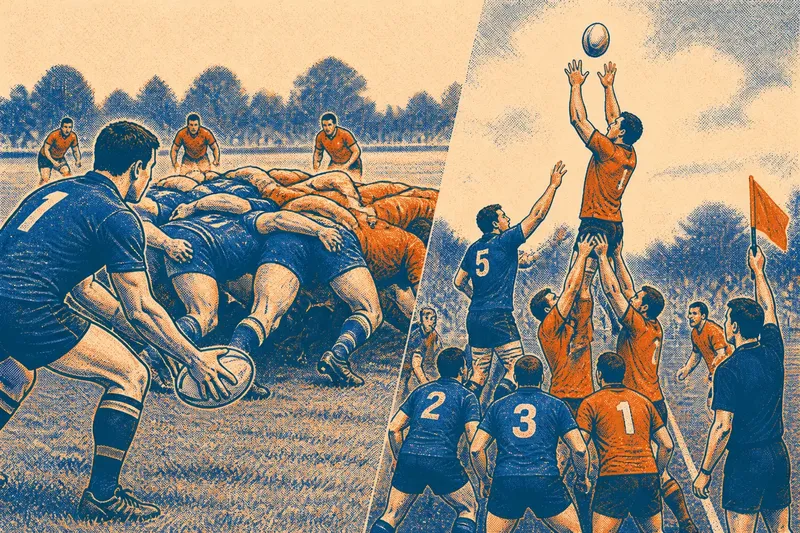
A knock-on stops play, and the referee signals a scrum. Later, a kick reaches touch and the teams form a lineout. Both restarts put the ball back in play, but a scrum or lineout gives the teams different ways to contest possession and build an attack.
How do scrum and lineout restarts differ?
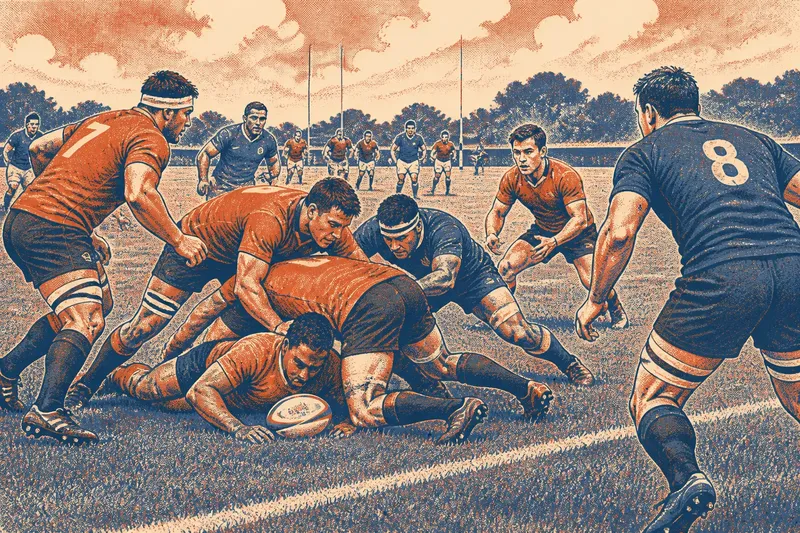
A scrum brings the opposing forward packs together around the ball. A lineout forms beside the touchline, where the team entitled to throw sends the ball between two lines of players. The incident and its location determine which restart applies, subject to the laws and any available options.
The distinction is not simply which team gets the ball. Both restarts allow a contest, and either can produce possession for the opposing side or another stoppage. The setup changes what each team can do before the ball is played and what attacking shape is available afterward.
How does a scrum work under the laws?
At a scrum, players bind and engage in the prescribed sequence. The scrum-half of the team awarded the scrum throws the ball into the tunnel from the side of the put-in. The ball must be thrown in without delay and without bias toward either side. The players in the scrum may use their feet to move it toward their own side; they do not simply compete by pushing until one pack wins.
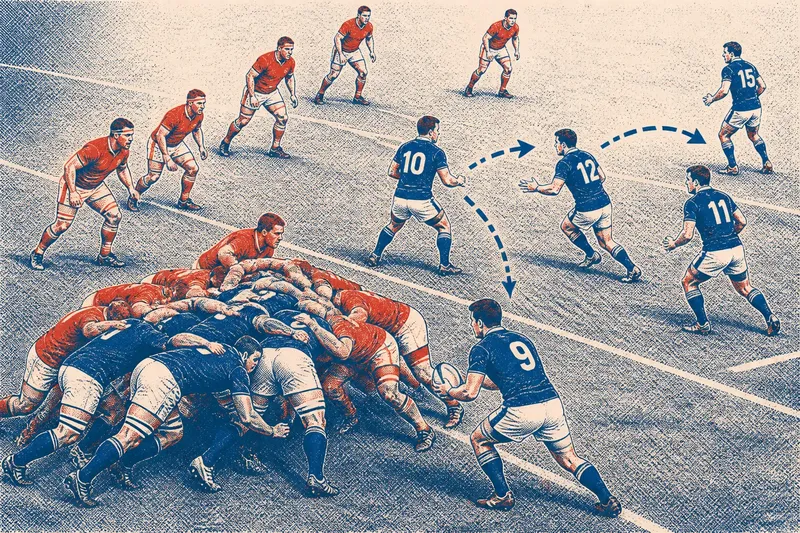
Once the ball is available at the back of the scrum, the scrum-half can play it. The team may use a short pass to a forward, pass to the backs, or choose another lawful option. The defending side watches the scrum and the players positioned behind it, but the attacking choice can change in response to the defensive setup.
A scrum does not ensure clean possession. The ball can be difficult to control, and infringements or instability can lead to a penalty or another stoppage. For viewers, the useful details are the put-in, whether the ball travels back toward the putting-in side, and how quickly it is played away.
What can a team do from a lineout?
At a lineout, players from both teams form lines parallel to the touchline. The team entitled to throw sends the ball down the middle channel. Teammates may lift a jumper to contest it, provided the lifting and lowering are legal. The receiver can catch the ball or tap it to a teammate.
The throwing team can signal a target or pattern, while the opposition can contest the throw and read the formation. A clean catch may give the team time to set up a pass, carry, or maul if the laws’ conditions are met. A tap or disrupted take can leave the next action less controlled.
The touchline shapes the available space. A team may move the ball toward the middle, attack close to the boundary, or form a maul around the receiver. The defense must respond to the ball and the developing shape, rather than assuming the throw’s target determines the next move.
What should you look for at a scrum or lineout?
- Identify the restart. If the referee awards a scrum, follow the put-in and the ball’s route through the pack; if a lineout is called, note which team throws and where the throw is aimed.
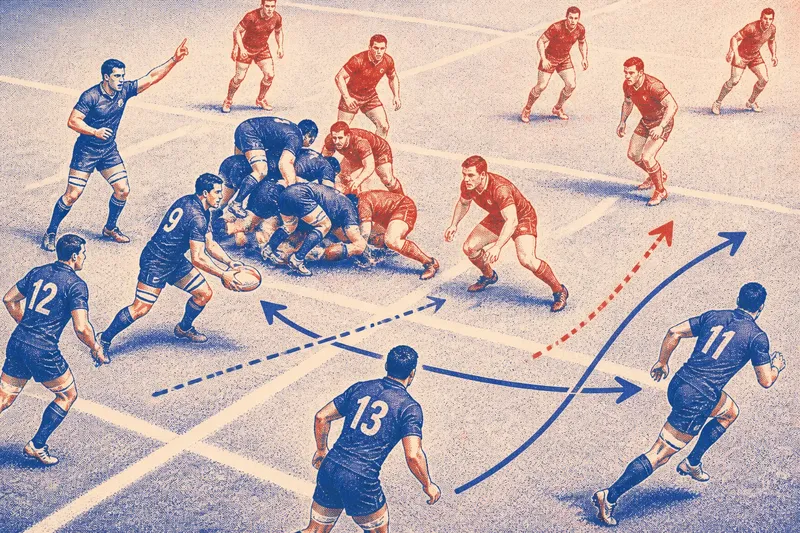
- Check the position on the field. If a scrum is near the middle, watch how the backs are spread; if it is near touch, notice how the boundary limits space on one side.
- Read the formation. If the scrum-half is close behind the pack with backs set wide, expect the possibility of a pass outward; if the lineout has a likely jumper and a player waiting behind the line, watch for a planned catch or tap.
- Track the contest. If the scrum ball moves back cleanly, watch for the scrum-half to play it; if it stays contested or the scrum becomes unstable, expect a whistle or a disrupted exit.
- Watch the first defensive reaction. If defenders close around a lineout receiver, look for the ball to move away from that pressure; if they spread early, watch for a direct carry or a change of direction.
- Follow the first action after possession. If the catch is clean, watch whether the team passes, carries, or forms a maul; if the take is messy, expect a scramble for control rather than a settled pattern.
What questions do viewers ask about these restarts?
Why does a knock-on commonly lead to a scrum?
A knock-on commonly results in a scrum awarded to the opposing team, which receives the put-in. The precise decision can depend on the incident and the applicable competition laws.
Does the team that throws into a lineout keep possession?
No. The throw can be contested, and the intended receiver may fail to catch or control it. The throwing team chooses a target, not the outcome.
Can a lineout lead to a maul?
Yes, if the relevant conditions are met, including a ball carrier held by teammates and opponents. If the ball is not held in that way, the team may instead pass or carry.
Is the scrum-half allowed to feed the ball straight into the scrum?
The scrum-half must throw the ball into the tunnel from the side of the put-in, without delay or bias toward either team. The precise scrum procedures are set by the current laws, so a competition-specific question is best checked against its governing rules.
How does the location change the likely options?
Imagine, hypothetically, a team has a lineout near the right touchline. Its planned target is a jumper near the front, and a teammate waits behind the line. The throw is caught cleanly, but defenders quickly gather around the receiver. The scrum-half sees that the direct route toward touch is crowded and passes back toward the field. The observable result is a move away from pressure, though the defense can still tackle the next carrier.
Now imagine, hypothetically, a scrum awarded near the middle after a knock-on. The team with the put-in has its backs spread out, while the opposing backs have moved inward. After the ball reaches the back of the scrum, the scrum-half passes outward. That choice attacks the space left by the narrow defensive shape; it does not make the attack certain to succeed.
For a scrum or lineout, the location and the team’s formation explain the options better than the restart name alone. Keep the laws in view, then watch how the first possession is used: the ball’s route, the defenders’ spacing, and the next pass or carry reveal the tactical choice without requiring a prediction about what must happen.